Two people, one engine, and a shared habit of walking on lava fields.
He started programming in 1983 to make video games for the Oric 1, then the Amstrad CPC, and went on to establish himself as an artist on the Atari and Amiga. In 1989, working with Paul Cuisset at Delphine Software, he did the graphics and animation for Future Wars - his first internationally acclaimed title.
He then developed Another World (1991) almost entirely on his own, from the code to the box cover. It went on to become a reference for its atmosphere and its minimalism.
In 1992 he joined the Amazing Studio team on Heart of Darkness, a cinematographic platformer that spent six years in development and was a considerable success on release in 1998.
Eric then disappeared from the games industry for a while, to explore volcanoes ! before returning to spend three years at Ubisoft on From Dust (2011). In 2014 the volcanoes continue to win, and this project started !
He then went on to Paper Beast (2020), a VR title built around simulated creatures and simulated terrain - another project where the world is computed rather than authored. François actively worked on it too ; that is how it ended up with a decade of shared habits about how a simulation should be built !
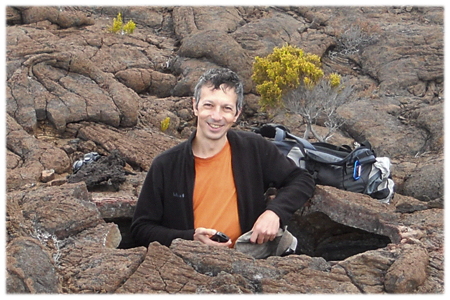
Eric Chahi, in a small lava tube on Réunion Island.
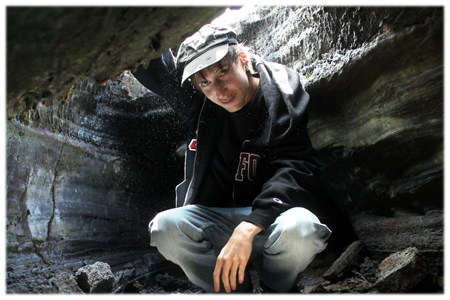
François Sahy, inside the same lava tube !
He started programming on MS-DOS in Basic at twelve, then studied computer science at EPFL in Switzerland, piano at the Lausanne Conservatory, and computer graphics at the Objectif 3D school in France.
In 2001 he starts writing the user interface of the SAINET ERP in C++/VCL.
Then worked on a custom GUI graphics library for C++ applications.
He is co-author of the Visualis Physics educational software used in a number of schools and universities - Visualis Electromagnetism (2003) for 3D visualisation of electromagnetic fields, and Visualis Dynamics (2006) for forces and gravitation.
He has written several 3D engines, including the one behind this project : an OpenGL 4.5 compute-shader pipeline where the fluid solver, the particle systems, the rigid blocks and the renderer all share the same GPU buffers.
He also wrote for this project a dynamic terrain/texture editor GPU Terrain Painter, using the simulation to shape natural terrains !
He then worked with Eric on Paper Beast (2020), which leans heavily on simulation of its own, sand, water, and creatures that evolve in real-time in a dynamic environment !
We are based in Montpellier, France, and we are always happy to talk about volcanoes.
